Lady Clarke’s terminal cancer
The A.B.C. MurdersLady Clarke’s terminal cancer is an incurable illness that governs the final period of her marriage to Sir Carmichael Clarke and complicates how others interpret her response to his death. It is not merely a medical fact in the investigation: the disease has weighed on Sir Carmichael, while Lady Clarke’s pain, treatment, and altered faculties shape the testimony about her state of mind and her relationship with him.
Diagnosis and its effect on Sir Carmichael
Franklin Clarke explains to the investigators that his sister-in-law is suffering from incurable cancer and cannot live much longer. He directly corrects the suggestion that his brother’s ordinary manner should be read as evidence of a particular disturbance: being upset and worried, he says, was Sir Carmichael’s normal condition. The disease supplies the reason. It had preyed terribly on Sir Carmichael’s mind, and Franklin says that, having recently returned from the East, he was shocked by the change in his brother.
The illness is thus presented as a continuing pressure on the household rather than as a sudden crisis. Sir Carmichael was a doctor and understood the seriousness of his wife’s condition; a nurse later observes that this knowledge made the situation especially hard for him, since he could not sustain himself with false hopes. She recalls that he was deeply worried and upset about Lady Clarke and that the illness preyed on his mind at first. Her qualification that it did so “to begin with” marks a change in how he bore the strain, not a recovery or a reversal in Lady Clarke’s prognosis.
Treatment and the limits of improvement
By the time Hercule Poirot visits, there has been some easing of Lady Clarke’s symptoms. Nurse Capstick describes her condition as “Not at all bad really, all things considered,” then explains that a new treatment has made things a little easier and that Dr Logan is pleased with her condition. The qualification matters: the improvement is relative to a grave, continuing illness, not a prospect of cure.
When Poirot asks whether Lady Clarke can ever recover, Nurse Capstick is shocked by the bluntness of the question. She says that they do not actually put it that way. The exchange reveals the difference between the medical certainty that recovery is impossible and the language used in caring for a patient. Treatment can relieve some of the burden without altering the terminal nature of the cancer.
Lady Clarke’s experience and the marriage
Poirot asks whether Sir Carmichael’s death was a terrible shock to his wife. Nurse Capstick answers with an important qualification: it was not as much of a shock as it would have been to someone in full possession of health and faculties. In her condition, things were dimmed for Lady Clarke. The nurse does not say that Lady Clarke was indifferent; she describes an illness that had blunted the force with which events reached her.
Asked whether the couple had been deeply attached to each other, Nurse Capstick answers yes: they had been a very happy couple. This testimony holds together two facts that might otherwise seem at odds. Lady Clarke’s illness muted her response to her husband’s death, but it did not erase the affection between them; Sir Carmichael’s anxiety was, in the nurse’s account, an expression of his care for a wife he knew he would lose.
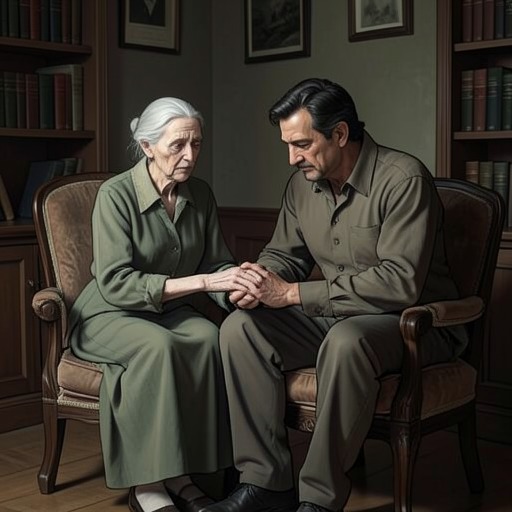
The visit makes the physical cost of that condition visible. In a former bedroom converted into a cheerful-looking sitting room, Lady Clarke sits in a large armchair by the window. She is painfully thin; her face is grey and haggard with pain, her gaze slightly distant and dreamy, and her pupils mere pinpoints. Nurse Capstick introduces Poirot in a high, cheerful voice, while Lady Clarke answers vaguely. The room’s brightness and the nurse’s brisk manner contrast with the patient’s visible suffering and remoteness.
Role in the investigation
The cancer affects how the investigators assess the people around Sir Carmichael. Franklin’s account presents his brother’s worry as the understandable consequence of his wife’s incurable illness, while Nurse Capstick’s recollections supply a longer view of the marriage, the burden of medical knowledge, and Sir Carmichael’s gradual adjustment to the strain. The illness therefore offers context for Sir Carmichael’s emotional state without, by itself, establishing what happened in the crime.
The novel also places this serious illness beside wider talk about disease and human vulnerability. When a young man objects that he does not approve of wars, his companion responds that he does not approve of plague, sleeping sickness, famine, or cancer either, but that such things happen all the same. The exchange does not make Lady Clarke’s particular suffering a mere abstraction: it sets the limits of personal approval against the reality of diseases that cannot be wished away. Her cancer remains concrete in the story—in the new treatment that eases her condition, the nurse’s careful refusal to promise recovery, and the pain and dimmed awareness Poirot observes—while its consequences extend into the grief and testimony surrounding Sir Carmichael’s death.